
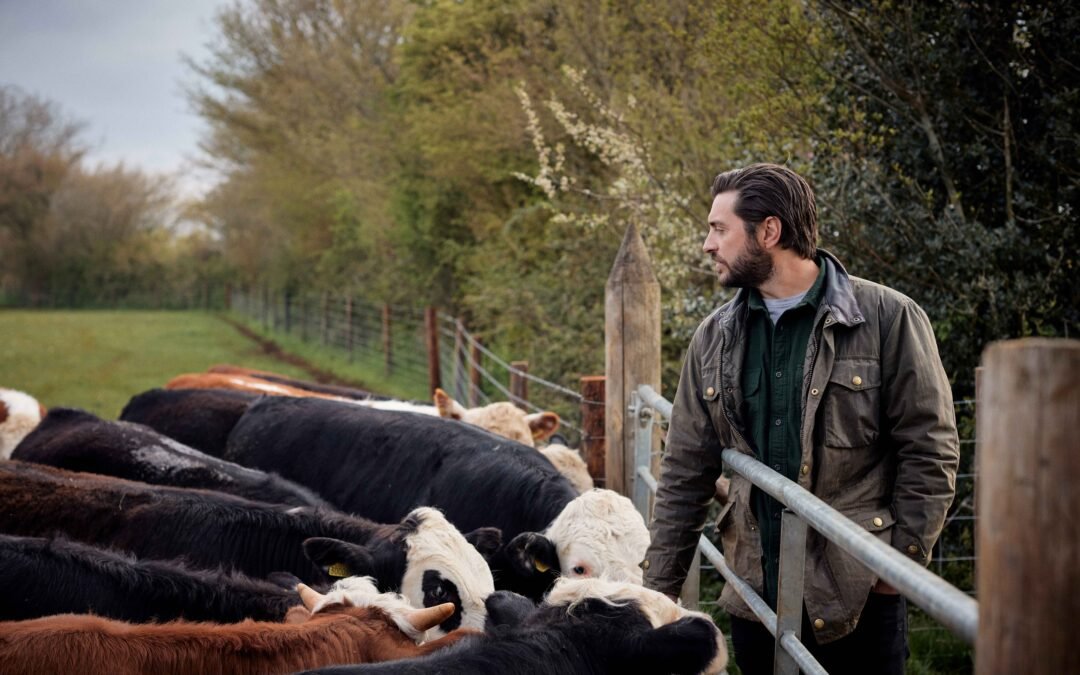
When our butchers cut a joint of beef for someone’s Christmas table, we’ve usually had a hand in it for well over two years.
The calf was born here at Hartley, drank milk from its mother and grazed the fields here in Winsley. And if you asked us when the work really started, we’d have to go back a little further, to choosing the right bull and the suckler cows we wanted to breed from in the first place.
Why we keep Herefords
We’re a small family farm, and one of the most important decisions we make is choosing cattle that do well on the grass we can grow. It’s why we keep Herefords.
I’m fond of them for their good looks, but what I appreciate most about this traditional British breed is its ability to grow and put on a good covering of fat on little more than grass. That matters when you’re the one trying to keep enough of it in front of their noses.
In the first few months, you’ll see the calves with their mothers, stopping for milk and, soon enough, putting their noses down to see what the summer pasture has to offer.
When the grass stops growing
If you walk through one of those fields, you’ll find quite a mixture underfoot. As part of our stewardship scheme, we grow grasses, legumes and herbs together. That gives the cattle a varied mouthful and, over the last few dry summers, we’ve had another reason to be grateful for it. When the grass has all but stopped growing, some of the other plants have kept a little green in the field.
Even so, there have been weeks in late summer when we’ve had to open bales of hay we’d put aside for winter. You’d sooner leave those bales stacked in the barn, but at a year old our cattle still have a fair bit of growing to do, whatever the weather has in mind.
This autumn the rain gave us a few more weeks of grass, so we could leave a few more bales in the stack. The yearlings are in the barn now, feeding on hay for the winter.
That’s how much of the farming happens here. You can plan your breeding years ahead and still find yourself changing the week’s plans according to which way the wind is blowing. Five generations of our family have farmed at Hartley, and a good deal of the craft is in those everyday judgements. When do you give a field a rest? When do you open the winter hay?
At the butcher’s block
There’s a craft to what happens in the farm shop, too. We dry-age our beef, giving the flavour time to develop, before Kev and the butchery team cut and prepare your joint.
Two ribs of beef can carry much the same description on a Christmas order form. What’s harder to see is the couple of years in the field, the time spent ageing, and the skill of the person at the block.
All of that carries a cost. We know a Christmas joint is a considered purchase, and we want you to know what you’re paying for. It’s also why, when we buy from the farmers we work with, we take pride in paying the price they ask. We know from our own farm how much of their work is done long before December comes around. I’m proud to invest in a food system that I believe in.
If you’re serving Hartley beef this Christmas, I hope that gives you a little picture of where it came from. And if you’re in the shop and curious about a cut or how best to cook it, ask us. One of the pleasures of farming here and having the butchery just across the yard is that we get to talk to the people who’ll be sitting down to eat it.